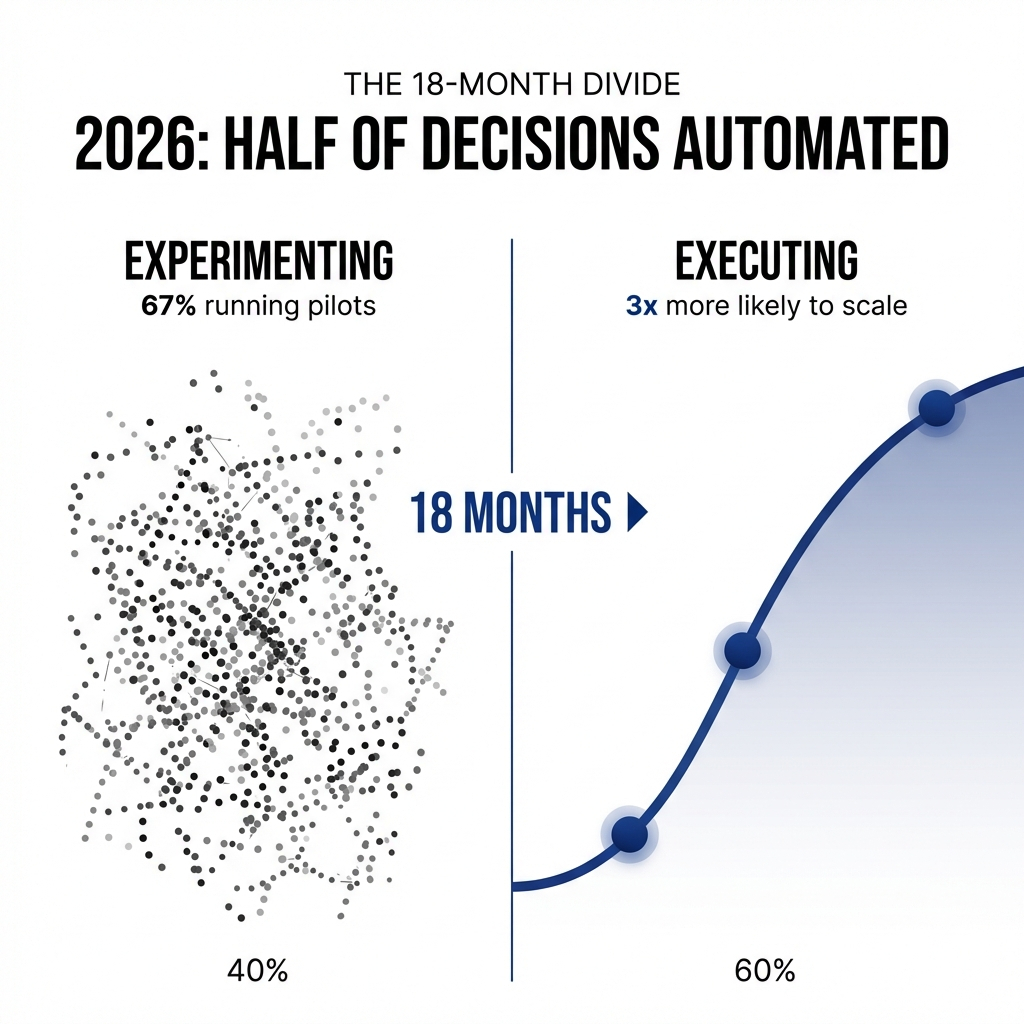
We're watching something strange unfold in organizations right now.
Companies are pouring billions into AI. They're hiring data scientists, launching pilot programs, and attending every conference with "AI" in the title. But 95% of these initiatives deliver zero measurable return.
The technology works. The problem is us.
The Real Problem Isn't the Technology
When AI projects fail, executives blame the usual suspects: regulation, model performance, lack of data. MIT's research tells a different story.
The failure happens at the integration layer. We're treating AI like a plug-in when it requires us to redesign how work actually gets done.
Think about it. You can't drop a powerful new tool into a broken workflow and expect transformation. But that's exactly what most organizations are trying to do.
The high performers understand this. They're nearly three times more likely to fundamentally redesign their workflows before implementing AI. They're not asking "Where can we add AI?" They're asking "How should this work be structured in the first place?"
When Expertise Becomes a Commodity
Here's what keeps me up at night: AI is rapidly commoditizing the very thing that used to set professionals apart.
Expertise.
Harvard Business School notes that generative AI is lowering the cost of expertise across industries. The capability gap between a Fortune 500 company and a small business is collapsing. What used to require years of specialized training can now be replicated by a tool anyone can access.
But before you panic, consider this: not all expertise is replicable.
Strategic judgment, emotional intelligence, the ability to navigate ambiguity—these remain distinctly human. The challenge is that many of us have built careers on expertise that AI can now deliver faster and cheaper.
The question becomes: what's your non-commoditizable value?
The Strategy Divide
We're seeing two approaches to AI implementation, and the results couldn't be more different.
Some organizations take a bottom-up approach. They crowdsource initiatives, let a thousand flowers bloom, and hope something sticks. It feels democratic. It rarely works.
The projects don't align with enterprise priorities. Execution lacks precision. Transformation never materializes.
The successful organizations do something different. They combine top-down strategy with bottom-up intelligence. Leadership identifies key workflows where AI can deliver meaningful impact. Domain experts surface problems and vet solutions. Power users who've already experimented with tools like ChatGPT lead adoption.
It's not about control versus chaos. It's about strategic orchestration.
The Leadership Gap Nobody's Talking About
Here's the uncomfortable truth: only 22% of respondents believe their leaders can effectively manage teams that combine humans and AI agents.
Yet that's exactly what we need to do.
CEOs are demanding AI skills and certifications. But talent acquisition leaders report that the skill they actually need most is critical thinking and problem-solving. AI skills rank fifth.
We're optimizing for the wrong thing.
The workforce is reshaping into an hourglass. AI agents handle midlevel work. Junior employees execute tasks. Senior professionals focus on strategy and innovation. The middle is hollowing out.
This isn't a future scenario. It's happening now. And most leadership development programs haven't caught up.
What Actually Works
The organizations getting this right share common patterns:
They redesign workflows first. Healthcare organizations using GenAI have reduced clinical appeals handling times by 70%. Not by adding AI to existing processes, but by rethinking the entire workflow.
They move fast. Mid-market firms scale AI initiatives in 90 days. Large enterprises take nine months. Speed matters because early adopters gain advantages that late adopters struggle to match.
They invest in translation skills. Management consulting roles now account for 12.4% of all GenAI-related job postings. The demand isn't just for people who understand AI. It's for people who can bridge the gap between technology and business outcomes.
They embrace governance. 60% of executives report that Responsible AI practices boost ROI and efficiency. But nearly half struggle to turn principles into operational processes.
The Real Work Ahead
We're not facing a technology challenge. We're facing a leadership and organizational design challenge that happens to involve technology.
The companies pouring resources into AI without rethinking their workflows will continue to see failure rates above 80%. The ones treating AI as a catalyst for fundamental redesign will pull ahead.
The gap between these two groups is widening. Late adopters face potential cash flow losses of up to 23%.
You have to choose which side you're on. And you have to choose soon.
Because the real question isn't whether AI will transform your organization. It's whether you'll lead that transformation or watch it happen to you.