We're watching organizations stumble at the same inflection point.
They've built the data infrastructure. They've hired the data scientists. They've launched the AI pilots.
But fewer than one in four have scaled those pilots to production.
The Shift From Experimentation to Execution
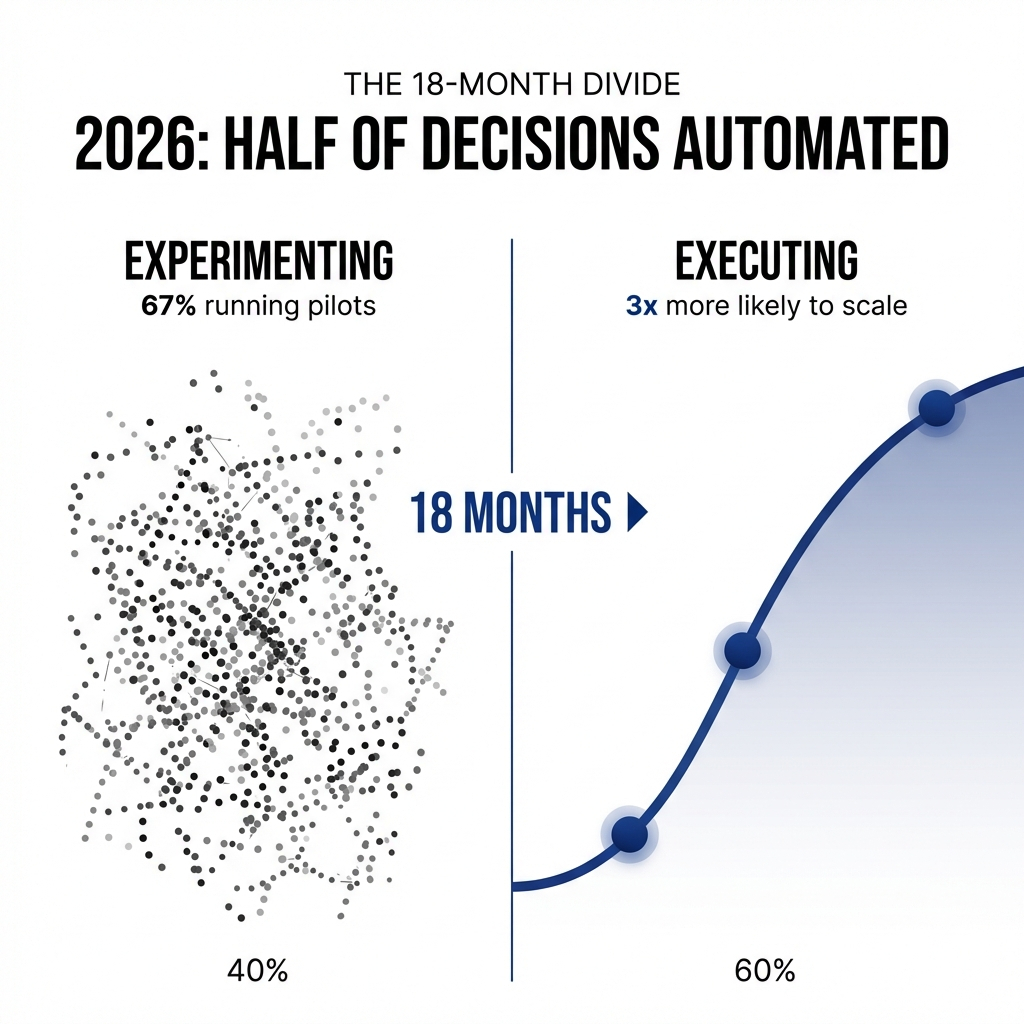
Gartner predicts that by 2026, half of business decisions will be augmented or automated by AI agents. That's not a gradual evolution. That's 18 months away.
The gap between prediction and reality sits in the execution layer.
Nearly two-thirds of organizations are experimenting with AI agents right now. But McKinsey's research shows that high-performing organizations are three times more likely to scale agents than their peers.
The difference? They redesigned workflows instead of layering agents onto legacy processes.
Decision Intelligence Replaces Data-Driven Theater
We've spent years building dashboards that nobody uses and reports that nobody reads.
Decision intelligence changes the conversation. It combines analytics, AI, and automation to improve decision-making speed, accuracy, and scalability. You're not just analyzing what happened. You're automating what happens next.
Anthropic's 2026 State of AI Agents report reveals that 57% of organizations now deploy AI agents for multi-stage workflows. Another 16% have progressed to cross-functional, end-to-end processes spanning multiple teams.
The pattern is clear. Organizations are moving from deploying agents to transforming around them.
The Semantic Layer Becomes Non-Negotiable
Here's what we're seeing in the infrastructure layer.
The semantic layer is transitioning from helpful to essential. Bruno Aziza, Group VP of Data, BI & AI at IBM, states that "semantic layers aren't just a trend—they're an essential foundation for trustworthy AI."
Why the urgency?
AI agents need consistent business definitions across multiple BI platforms, decision systems, and automation tools. Without a semantic layer, you're building agents that speak different languages about the same data.
Gartner's warning reinforces this. By the end of 2026, legal claims tied to AI decision automation may exceed 2,000 due to insufficient guardrails. Strong metadata, lineage, data product governance, and AI-model observability become non-negotiable.
The Production Reality Check
The AI agent market is expanding from $7.84 billion in 2025 to $52.62 billion by 2030. That's a 46.3% CAGR.
But market size doesn't equal market readiness.
Gareth Herschel, VP Analyst at Gartner, emphasizes that data and analytics leaders face mounting pressure to do "a lot more with a lot more" as D&A shifts from the domain of the few to ubiquity.
The solution sits in focus. Organizations must prioritize highly consumable data products and business-critical use cases. You can't scale everything. You shouldn't try.
What 2028 Looks Like
By 2028, real-time analytics will be fully AI-powered.
Gartner predicts that 30% of GenAI pilots that move into large-scale production will be built versus deployed using packaged applications. Organizations want lower costs and increased control.
This represents a complete integration of artificial intelligence in data analysis processes. The question stops being whether AI will make decisions. The question becomes which decisions you'll keep for humans.
The Path Forward
We're at the point where organizations separate into two categories.
The first group keeps experimenting. They run pilots. They collect use cases. They wait for perfect conditions.
The second group redesigns workflows around AI agents. They build semantic layers. They establish governance frameworks. They scale imperfectly and iterate.
The timeline is compressed. By 2026, 40% of enterprise applications will include task-specific AI agents. That's a coordination layer where different types of AI agents work together to run core business workflows at scale.
You're not building for the future anymore.
You're building for next year.
The organizations that understand this are already redesigning their decision architecture. They're moving from data transformation to decision transformation.
The gap between experimentation and execution is closing fast. The question is which side of it you'll be on when it does.