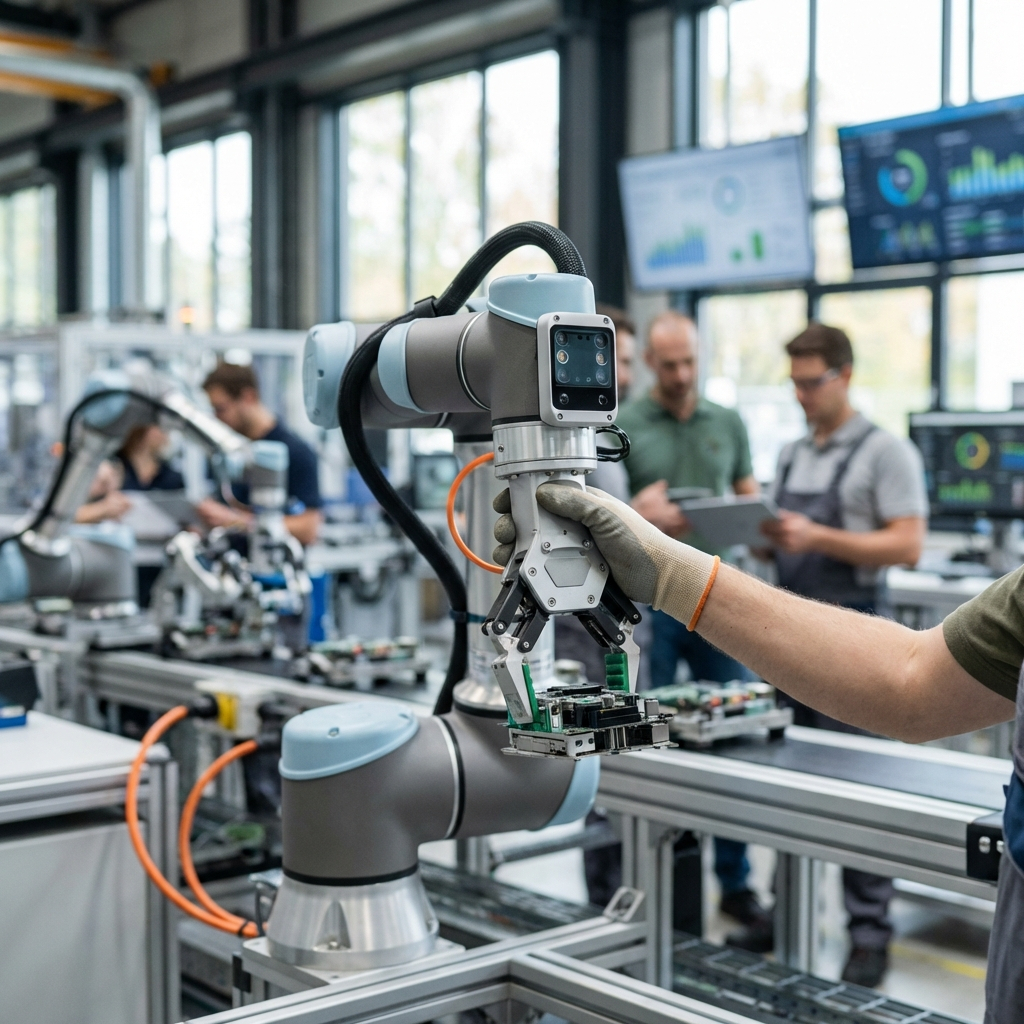
We've spent years watching AI live in the cloud. We've typed prompts, received responses, and marveled at what language models can do.
CES 2026 marked something different.
Jensen Huang stood on stage and declared we've reached "the ChatGPT moment for physical AI." He wasn't talking about better chatbots. He was talking about AI that moves, builds, and operates in the real world.
The show floor confirmed it. Over 30 Chinese robotics companies exhibited humanoid robots pushing toward commercial mass production. Boston Dynamics unveiled the production-ready Atlas with deployment scheduled at Hyundai's Georgia plant this year. Samsung, LG, Intel, AMD, and Qualcomm all showcased AI embedded directly into devices.
Something fundamental shifted. AI stopped being a feature you access through a screen and became something embedded in the objects around you.
The Infrastructure Overhaul Nobody's Talking About
Huang put a number on what's happening: "$10 trillion or so" of computing infrastructure from the last decade needs modernization to accommodate this shift.
That's not an upgrade. That's a complete rebuild.
AMD CEO Lisa Su added context. She predicts 5 billion people will use AI daily within five years, requiring computing capacity to increase 100 times. You can't deliver that kind of scale from centralized data centers alone.
The solution? Push intelligence to the edge. Put it in the device. Make it local.
NVIDIA's new Rubin platform aims to slash token generation costs to one-tenth of previous platforms. Intel launched Core Ultra Series 3 on its 18A process, delivering 1.9x higher large language model performance for edge workloads. These aren't incremental improvements. They're making physical AI economically viable at scale.
From Prototype to Production Floor
Walk through previous CES events and you'd find robots posing for photos. Impressive demos. Carefully controlled environments.
CES 2026 showed robots working.
Boston Dynamics' Atlas features 56 degrees of freedom, a 7.5-foot reach, and 110-pound lifting capacity. It's not a research platform anymore. It's heading to factory floors.
Huang described the NVIDIA-Siemens partnership enabling physical AI from design through production. His phrase: "These manufacturing plants are going to be essentially giant robots." The first AI-driven factory blueprint debuts this year at Siemens' electronics plant in Germany.
The shift from demonstration to deployment matters. It means companies have moved past "can we do this?" to "how do we scale this?"
One observer noted that AI hardware at CES 2026 "finally moved behind the scenes and integrated into everything." The technology stopped being the story. The applications became the story.
What This Means for the Next Five Years
Physical AI creates a different set of challenges than cloud-based AI.
When AI operates in the real world, it needs to handle unpredictability. It needs to respond in milliseconds, not seconds. It needs to work without constant connectivity to data centers.
That's why edge computing matters. That's why companies are racing to build chips that can run sophisticated models locally.
Huang demonstrated a personalized AI agent running on local hardware and embodied through a physical robot. His observation: "The amazing thing is that is utterly trivial now, but yet, just a couple of years ago, that would have been impossible."
The acceleration is real. What seemed impossible 24 months ago now runs on consumer hardware.
CES introduced a new zone called CES Foundry specifically for AI and quantum technologies. The organizers recognized that AI has become central enough to warrant dedicated space separate from traditional consumer electronics.
The message is clear: AI integration into physical products isn't a trend. It's the foundation for the next generation of computing.
The Questions We Need to Ask
This shift brings practical implications worth considering.
When devices process data locally, privacy dynamics change. When robots operate autonomously in shared spaces, safety standards need updating. When AI systems can physically manipulate environments, the stakes for reliability increase.
We're also looking at workforce transformation. Factory floors with AI-driven systems. Hospitals with robotic assistants. Homes with embodied intelligence handling routine tasks.
The technology is moving faster than our frameworks for managing it.
CES 2026 showed us the hardware is ready. The chips can handle the workload. The robots can perform the tasks. The economics are starting to work.
What we do with that capability determines whether this becomes a story about efficiency gains or a story about fundamental transformation in how we work, live, and interact with technology.
The physical AI moment has arrived. The question isn't whether it's coming. The question is how we shape what comes next.